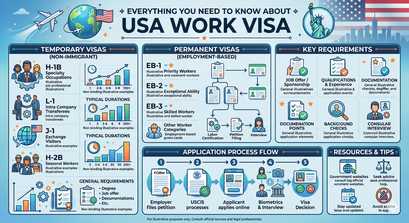
Getting to know more about USA job grant visa sponsorship opportunities, you are probably looking for one thing: a legitimate path to work in the United States through an employer that is willing to support your visa process. The important thing to understand is that “job grant visa sponsorship” is not the official name of a single U.S. visa programme. In real immigration practice, most work pathways are based on employer sponsorship, labour certification where required, and a formal visa or immigrant petition filed under specific U.S. immigration rules.
That distinction matters because a lot of people waste months chasing fake offers, invented “grant visas,” and vague promises of relocation support. The real U.S. system is more structured than that. For temporary work, many categories require the employer to handle the labour certification step first, then file Form I-129 with USCIS. For permanent employment-based immigration, the employer often needs a labour certification and then files Form I-140. In other words, the opportunity is real, but it sits inside formal sponsorship routes, not a mystery grant scheme.
So, what should job seekers actually focus on? You should focus on real visa sponsorship jobs in the USA, employment-based green card pathways, seasonal work programmes, and industries where employers have a persistent need for foreign talent or labour. If you approach the search with the right terminology, the right target industries, and the right documents, your chances improve dramatically.
This guide breaks down the best U.S. sponsorship routes, the sectors with the strongest commercial hiring intent, and the exact steps to move from “I want a sponsored job in America” to “I am applying to the right employers with the right strategy.”
What “USA Job Grant Visa Sponsorship Opportunities” Really Means
In search language, this phrase usually combines several ideas: a U.S. job offer, an employer willing to sponsor a visa, and sometimes additional support such as relocation assistance, onboarding help, or training. But the U.S. government framework itself is built around specific work-authorised categories, not a general-purpose job grant. Temporary worker categories sit under defined visa classifications, while permanent roles usually fall into employment-based immigrant categories such as EB-2 and EB-3.
That means your first goal is not just “find any U.S. employer.” Your first goal is to match yourself to the right sponsorship lane. A software engineer and a farm worker do not enter through the same channel. A registered nurse and a seasonal hotel worker do not follow the same process. A multinational manager already working abroad for a global company may qualify under a completely different route from someone trying to land their first U.S. offer from overseas.
Once you understand that, the market becomes clearer. You stop chasing generic promises and start targeting real opportunities such as H-1B visa sponsorship jobs, H-2A farm jobs, H-2B seasonal jobs, EB-3 sponsorship roles, Schedule A nursing opportunities, and intracompany transfer routes.
How U.S. Visa Sponsorship Works
At a high level, U.S. employment sponsorship works in one of two ways.
The first is temporary employment sponsorship. In these cases, a U.S. employer petitions so a foreign national can work in the country for a defined role or duration. Some of these categories are cap-limited, some are seasonal, and some are highly specialised. The employer generally drives the formal process. For many temporary categories, the employer may need labour certification first, then file Form I-129, and only after USCIS approval can the worker proceed to the visa stage with a U.S. embassy or consulate.
The second is permanent employment sponsorship, often referred to as employment-based immigration or a green card through work. In many of these cases, the employer first goes through the Department of Labor labour certification process and then files Form I-140. The Department of Labor states that the filing responsibility belongs to the employer, not the employee, and that the system is designed to ensure the hiring of a foreign worker does not adversely affect U.S. workers’ wages and working conditions.
This is why your strategy has to be employer-centred. Many foreigners think the main question is, “Can I work in the U.S.?” In practice, the main question is, “Which employer has a business reason, a legal pathway, and enough urgency to sponsor me?”
The Best U.S. Visa Sponsorship Pathways for Foreigners
1. H-1B Visa Sponsorship Jobs
The H-1B route is one of the most recognised options for degree-holders. USCIS describes it as a classification for people who will perform services in a specialty occupation. That usually means the role requires specialised knowledge and a corresponding academic background or equivalent. The H-1B process also runs through an electronic registration process in cap-subject cases, which makes it competitive rather than open-ended.
This route is most relevant for professionals in technology, engineering, data, finance, healthcare-adjacent professional roles, architecture, research, and similar fields. If you are searching for jobs in USA for foreigners with visa sponsorship and you hold a bachelor’s or advanced degree in a role that clearly maps to a specialty occupation, H-1B should be one of your top targets.
2. H-2A Visa Sponsorship for Farm and Agricultural Jobs
The H-2A route is designed for temporary or seasonal agricultural work. USCIS states that this programme allows U.S. employers or agents to bring foreign nationals to the United States to fill temporary or seasonal agricultural jobs. This is one of the clearest routes for job seekers targeting farm work, harvest labour, greenhouse roles, and other seasonal agricultural opportunities.
For people searching terms like farm jobs in USA with visa sponsorship or agricultural jobs in America for foreigners, H-2A is often the most relevant and legitimate framework. It is not a “shortcut visa,” but it is a real employer sponsorship route.
3. H-2B Visa Sponsorship for Seasonal Non-Agricultural Work
The H-2B route is for temporary non-agricultural workers. USCIS explains that it allows qualifying U.S. employers or agents to bring foreign nationals to the United States to fill temporary non-agricultural jobs. These roles often appear in hospitality, landscaping, tourism, seafood processing, maintenance, resort operations, and other labour-intensive seasonal sectors.
This route is especially important for people searching phrases like seasonal jobs in USA with sponsorship, hotel jobs in USA with visa sponsorship, or housekeeping jobs in USA with sponsorship. It is also a reminder that not every U.S. sponsorship opportunity requires a university degree. Some of the most accessible sponsored roles sit inside seasonal labour demand.
4. EB-2 Sponsorship for Advanced Degree and Exceptional Ability Professionals
The EB-2 category is an employment-based immigrant path for professionals holding advanced degrees or people with exceptional ability. The Department of State explains that EB-2 generally requires a job offer, a U.S. employer filing Form I-140, and an approved labour certification, although a National Interest Waiver (NIW) can exempt a qualified applicant from the job offer and labour certification requirement if the case qualifies as being in the national interest.
This matters for senior professionals, researchers, high-level technical experts, and certain founders or specialists. If your experience is strong and your profile sits above entry level, EB-2 may be more strategic than only chasing temporary visa sponsorship jobs.
5. EB-3 Sponsorship for Skilled, Professional, and Certain Other Workers
The EB-3 category is one of the most practical permanent-work routes for many foreign applicants. According to the Department of State, EB-3 includes skilled workers whose jobs require at least two years of training or experience, professionals whose jobs require at least a bachelor’s degree, and other workers in roles requiring less than two years of training or experience, provided the jobs are not temporary or seasonal. These cases generally require employer sponsorship and labour certification.
This is why EB-3 visa sponsorship jobs attract so much attention online. For many foreigners, especially those outside the pure white-collar H-1B world, EB-3 can be the more realistic long-term route. It is particularly relevant for employers filling chronic staffing gaps in healthcare, trades, operations, food production, and selected support roles.
6. Schedule A Opportunities for Nurses and Physical Therapists
One of the strongest high-intent sponsorship areas is healthcare, especially for professional nurses and physical therapists. U.S. regulations list these occupations under Schedule A Group I, which means they receive special treatment within the labour certification framework because the government has pre-identified shortage conditions for those occupations. The regulation specifically names physical therapists and professional nurses, and it also lists qualifying evidence for nurses such as a CGFNS certificate, a full and unrestricted state nursing licence, or a passed NCLEX-RN.
For applicants searching nurse jobs in USA for foreigners with visa sponsorship, this is one of the clearest and strongest routes in the market. It is also one of the few areas where the demand signal, the visa structure, and the occupation shortage language align unusually well.
7. L-1 Intracompany Transfer for Multinational Employees
The L-1 route is not a general open-market sponsorship path, but it is highly valuable if you already work for a multinational company. The Department of State describes it as an option for applicants working in a managerial, executive, or specialised knowledge role for a branch, parent, affiliate, or subsidiary of the same employer, with at least one year of qualifying work abroad within the preceding three years.
This is one of the smartest paths for professionals who already work in global firms and want to move into the U.S. without starting their search from zero.
Industries with the Strongest USA Visa Sponsorship Opportunities
Healthcare
Healthcare remains one of the most compelling sectors for foreigners seeking sponsorship. The Bureau of Labor Statistics says healthcare occupations overall are projected to grow much faster than the average for all occupations from 2024 to 2034, with about 1.9 million openings each year on average. Registered nurses alone are projected to have about 189,100 openings annually, and home health and personal care aides about 765,800 openings annually over the decade.
This does not mean every healthcare employer sponsors visas. It does mean the sector has scale, structural demand, and clear shortage-driven pressure. For nurses especially, the combination of market need and Schedule A treatment makes healthcare one of the best sectors for USA job grant visa sponsorship opportunities in practice.
Technology and Software
Tech is still a major sponsorship sector, particularly for roles tied to engineering, software, data, cloud, cybersecurity, and product development. BLS projects overall employment in computer and information technology occupations to grow much faster than the average for all occupations from 2024 to 2034, with about 317,700 openings each year on average. Software developers, QA analysts, and testers alone are projected to see 129,200 openings annually and 15% growth across the same period.
This is why search terms like H-1B visa sponsorship jobs, software engineer sponsorship USA, and data analyst jobs in USA with visa sponsorship stay commercially powerful. Tech employers may be selective, but when your skills are aligned and your profile is strong, the opportunity pool is still significant.
Agriculture
Agriculture is one of the clearest sponsorship sectors because it has a dedicated temporary work pathway. H-2A exists specifically for temporary or seasonal agricultural labour, and the Department of Labor updates H-2A processing data regularly. As of April 2026, the DOL processing times page showed average processing times of 19 calendar days for complete H-2A cases over the prior two weeks.
For applicants targeting farm, field, and seasonal harvest work, agriculture remains one of the most direct channels into legitimate U.S. employment sponsorship.
Construction and Skilled Labour
Construction is another promising sector, especially for workers searching construction jobs in USA with sponsorship. BLS projects employment of construction laborers and helpers to grow 7% from 2024 to 2034, with about 149,400 openings each year on average. The broader construction and extraction group is also projected to grow faster than average, with about 649,300 openings annually.
Not every construction role translates neatly into every visa category. But from an opportunity standpoint, construction belongs on every serious foreign job seeker’s radar, especially where employers face sustained labour shortages and can justify sponsorship under the right structure.
Transport and Logistics
Transport, delivery, and logistics remain important because the U.S. market continues to show large replacement needs and steady openings. BLS projects 237,600 annual openings for heavy and tractor-trailer truck drivers and 171,400 annual openings for delivery truck drivers and driver/sales workers from 2024 to 2034.
Again, labour demand alone does not equal automatic sponsorship. But it does signal where staffing pain exists. When you pair that with employer need, the right licensing, and the right legal route, these sectors become commercially relevant for sponsorship searches.
The Temporary vs Permanent Question
One of the biggest mistakes foreigners make is assuming every sponsored U.S. job automatically leads to a green card. It does not.
Temporary visas such as H-1B, H-2A, H-2B, and L-1 are built for temporary or defined-purpose employment. Permanent employment pathways such as EB-2 and EB-3 are built around immigrant visa categories and long-term employment sponsorship. The Department of State separates these routes clearly, and the petition forms differ too: temporary workers usually move through I-129, while permanent workers usually move through I-140 after the labour certification step where required.
That means your strategy should depend on your goal. If your priority is fast entry into the U.S. labour market, a temporary route may be the practical starting point. If your goal is long-term settlement, it may make more sense to target employers and occupations that support EB-2 or EB-3 sponsorship.
What Employers Look for Before They Sponsor
A U.S. employer usually sponsors only when there is a clear business case. That business case can be skill scarcity, labour shortage, seasonal demand, shift coverage, specialised expertise, or the fact that the employer already knows you through a multinational structure.
In practical terms, employers are more likely to sponsor when you bring at least one of these advantages:
You have skills that are hard to replace locally.
You hold a licence or credential required for the role.
You have direct experience in the employer’s exact industry.
You can start with minimal retraining.
You understand the compliance burden and present yourself as organised, credible, and serious.
This is why your résumé matters so much. A foreign applicant seeking visa sponsorship should never submit a generic résumé. Your CV should be tightly matched to the employer’s shortage point. If you are a nurse, make your licensure readiness obvious. If you are a software engineer, make your stack, production impact, and domain experience easy to scan. If you are targeting seasonal work, highlight stamina, shift reliability, equipment familiarity, and prior volume-based work.
Step-by-Step: How to Find Real Sponsored Jobs in the USA
Step 1: Choose the Right Sponsorship Lane
Do not start by applying everywhere. Start by deciding which lane fits you best.
If you are degree-qualified in a professional field, start with H-1B, EB-2, or EB-3 professional roles.
If you are a nurse or physical therapist, prioritise Schedule A healthcare pathways.
If you want seasonal labour work, focus on H-2A and H-2B employers.
If you work for a multinational firm, explore L-1 transfer potential.
Step 2: Search With Commercial-Intent Keywords
Use the language employers and recruiters actually use. Strong search examples include:
- visa sponsorship jobs in USA
- jobs in USA for foreigners with visa sponsorship
- H-1B visa sponsorship jobs
- EB-3 visa sponsorship jobs
- nurse jobs in USA for foreigners
- seasonal jobs in USA with sponsorship
- farm jobs in USA with visa sponsorship
- construction jobs in USA with sponsorship
- truck driver jobs in USA for foreigners
- relocation assistance jobs USA
Those phrases are closer to real market language than vague searches for “grant visa jobs.”
Step 3: Check Whether the Employer Has a Real Process
A real sponsor usually has one or more of the following:
- a structured careers page
- an HR or legal process for immigration support
- role descriptions that mention sponsorship or work authorisation
- a history of hiring international workers
- clear documentation steps rather than informal promises
Remember: for many sponsorship routes, the employer has formal filing responsibility. If a supposed recruiter asks you to “handle everything yourself” for an employer-sponsored route, that is a red flag.
Step 4: Prepare Your Documents Early
Before interviews begin, prepare:
- passport
- updated CV tailored to U.S. employers
- educational records
- professional licences if applicable
- employment references
- proof of work history
- exam results or credential evidence where required
- a short explanation of your sponsorship need
For healthcare applicants, licensing readiness can be decisive. For example, the U.S. regulation for professional nurses under Schedule A specifically references CGFNS, state licensure, or NCLEX-RN passage as qualifying evidence.
Step 5: Understand That Timelines Vary
Visa timelines are not identical across cases. Processing depends on category, filing volume, embassy location, season, and whether the case is temporary or permanent. The Department of State notes that visa interview wait times vary by location, season, and visa category, and the Department of Labor’s April 2026 processing page showed PERM averages of 501 days for analyst review and 343 days for audit review as of March 2026, with a reminder that actual case times vary.
So, build your strategy around reality, not fantasy. Some routes move faster. Some routes are slower but more permanent.
Red Flags and Scam Warnings
Because sponsorship has real market value, scams are everywhere. Be cautious if you see any of the following:
A “guaranteed U.S. visa sponsorship job” with no formal interview.
A promise of a “grant visa” that cannot be tied to a real visa category.
A request for large upfront money to secure a job offer.
An employer with no verifiable website, office, or compliance process.
A recruiter who cannot explain the visa category being used.
A promise that a tourist visa can simply be converted into work authorisation without the normal legal route.
Temporary workers also have rights in the U.S. government’s own guidance. The Department of State states that all temporary workers and employers must follow U.S. laws, and that workers can seek help if they face violations or abuse. It also states plainly that, regardless of immigration status, an employer cannot lawfully mistreat a worker or refuse pay for exercising their rights.
That is why the safest path is always the formal one: real employer, real petition, real category, real paperwork.
The Best Applicant Profiles for U.S. Sponsorship in 2026
The strongest candidates for U.S. sponsorship opportunities right now usually fall into one of these groups:
Licensed healthcare professionals, especially nurses and physical therapists, because the legal framework is unusually clear and the demand signal is strong.
Technical and professional degree-holders in roles that fit the specialty occupation model or advanced-degree pathways, such as software, engineering, analytics, research, and certain finance or compliance functions.
Seasonal and agricultural workers who are prepared to work through structured H-2A or H-2B programmes rather than chasing vague promises online.
Experienced skilled workers in occupations where employers can justify longer-term sponsorship under EB-3.
Employees already inside multinational organisations who can move through L-1 instead of trying to win a brand-new sponsored job from abroad.
Frequently Asked Questions
Is there really a U.S. “job grant visa”?
Not as a formal visa category. What people usually mean is a job with employer visa sponsorship, sometimes plus relocation or onboarding support. The real legal routes are employer-petition-based temporary and permanent visa categories.
Which U.S. visa is easiest to get through a job?
There is no universal “easiest” route. It depends on your occupation and the employer’s need. For seasonal agricultural work, H-2A is often the clearest fit. For seasonal non-agricultural roles, H-2B may be relevant. For degree-based professional work, H-1B may fit. For long-term permanent sponsorship, EB-2 or EB-3 may be the target.
Can a U.S. employer sponsor me for a green card directly?
Yes, in many employment-based immigrant cases, but the employer often must complete labour certification first and then file Form I-140. Some categories, such as certain extraordinary ability cases and some NIW cases, allow self-petitioning instead.
Are nurses in demand for U.S. sponsorship?
Yes. Registered nursing shows substantial projected openings according to BLS, and professional nurses are specifically listed in Schedule A Group I under U.S. regulations.
How long does visa sponsorship take?
It varies by route. Temporary worker timelines depend on petition approval and consular timing, while permanent sponsorship timelines can be much longer. The Department of Labor’s published April 2026 processing update showed PERM averages stretching well beyond a year in some queues, and the Department of State notes that interview wait times vary by location and season.
Final Thoughts
The biggest advantage you can give yourself in this market is clarity. Stop searching for mythical shortcuts. Start targeting real visa sponsorship jobs in USA, EB-3 sponsorship opportunities, H-1B roles, Schedule A healthcare openings, and seasonal employer-sponsored jobs that sit inside the legal framework the U.S. government already recognises.