Searching for plumber jobs in the USA with visa sponsorship for foreigners, you are looking at one of the more practical skilled-trade pathways in the American labour market. Plumbing is not a desk job that can easily be outsourced. It is essential, local, technical, and tied to construction, maintenance, public safety, and property operations. That matters because the U.S. still needs plumbers for new buildings, repairs, retrofits, water systems, and code-compliant installations. The U.S. Bureau of Labor Statistics says plumbers, pipefitters, and steamfitters had about 504,500 jobs in 2024, with employment projected to grow 4% from 2024 to 2034, and about 44,000 openings per year on average over the decade.
That does not mean every plumbing company in America is ready to sponsor a foreign worker. It does mean there is real market demand, a clear trade structure, and a legitimate immigration fit for some employers. In the best cases, sponsorship happens when a U.S. employer has a hard-to-fill role, needs reliable skilled labour, and is willing to handle the formal process required under U.S. immigration and labour rules. For a foreign applicant, that creates an opportunity, but only if you understand the difference between temporary visa sponsorship and permanent skilled-worker sponsorship.
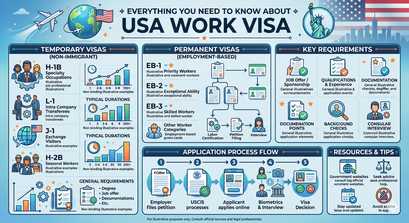
The biggest mistake many applicants make is assuming that “visa sponsorship” is one single thing. It is not. For plumbing and related trades, the two most relevant routes are usually H-2B for temporary non-agricultural work and EB-3 skilled worker sponsorship for permanent employment. Those two options serve different employer needs, different job structures, and different long-term outcomes for the worker. If you understand that difference early, you will search smarter, apply better, and avoid wasting time on the wrong type of opportunity.
Why Plumbing Is a Strong Option for Foreign Workers
Plumbing is a solid target because it combines technical skill with constant real-world demand. Homes need working water and drainage. Commercial buildings need compliant installations and repairs. Hotels, hospitals, factories, schools, and warehouses all depend on functioning pipe systems. The BLS notes that plumbers work in homes, businesses, factories, and other places with pipe systems, and that demand comes both from new construction and from the need to maintain and repair existing systems.
This matters from an immigration angle because employers are more likely to sponsor when a role is operationally necessary, expensive to leave vacant, and hard to replace quickly. A broken office pipe, a delayed commercial build, or a maintenance backlog in a large facility has a direct business cost. That practical pressure makes plumbing more attractive than many lower-skill roles that are easier to fill locally. In addition, the trade has a structured skills ladder: helper, apprentice, journeyman, master plumber, supervisor, and project lead. That structure gives employers clearer ways to assess experience from foreign candidates. The BLS also notes that journey- and master-level plumbers often direct apprentices and helpers, which shows how the field naturally rewards experience and progression.
Another advantage is pay. According to BLS data, the median annual wage was $62,970 in May 2024, with the lowest 10% earning under $40,670 and the highest 10% earning over $105,150. In other words, plumbing is not merely “a job”; it can be a stable middle-income or better career, especially once licensing, overtime, emergency work, specialisation, or supervisory duties are added.
Can Foreigners Really Get Plumber Jobs in the USA With Visa Sponsorship?
Yes, but only under the right conditions. The U.S. immigration system does allow employers to sponsor foreign workers for jobs when legal requirements are met. For permanent roles, the Department of Labor’s permanent labour certification process exists so an employer can hire a foreign worker to work permanently in the United States after demonstrating that there are not sufficient U.S. workers who are able, willing, qualified, and available, and that hiring the foreign worker will not adversely affect U.S. wages and working conditions. For temporary roles, the H-2B program allows employers to bring foreign workers for temporary non-agricultural work when they can show a temporary need and a shortage of available U.S. workers.
For plumbers specifically, sponsorship is most realistic in two situations. The first is where a company has a genuine long-term need for an experienced tradesperson and is willing to pursue an EB-3 skilled worker case. USCIS states that the EB-3 skilled-worker category requires jobs that need at least two years of training or experience. The second is where an employer has a temporary labour need, such as seasonal construction, peak project demand, or intermittent operational pressure, and uses the H-2B route.
So yes, it is possible. But it is not casual. Sponsorship happens because an employer has a business need and is ready to document that need. That is why your goal should not be “find any U.S. plumbing job.” Your goal should be “find employers whose staffing model, project type, and hiring urgency make sponsorship commercially sensible.” That is a much better search strategy.
The Main Visa Paths for Plumber Jobs in the USA
1. EB-3 Skilled Worker Sponsorship
For many foreigners, EB-3 is the more attractive route because it is tied to permanent employment rather than temporary labour. USCIS says the EB-3 skilled-worker category is for jobs requiring at least two years of training or experience, and the Department of Labor explains that permanent labour certification allows an employer to hire a foreign worker for permanent work in the United States before the employer moves the case forward with USCIS.
This makes EB-3 especially relevant for experienced plumbers, pipefitters, steamfitters, and technically trained workers who already have years of hands-on trade experience. In practical terms, EB-3 is often a better fit for employers looking for a stable full-time worker rather than someone to cover only a seasonal rush. If a contractor, facilities company, or industrial employer wants someone for an ongoing role, the EB-3 structure is usually more aligned with that need. That is an inference from how the permanent labour certification framework and skilled-worker standard are designed.
A critical point here is that the process is employer-driven. The Department of Labor explicitly says the filing of permanent labour certification applications is the responsibility of the employer, not the employee. That means you do not “apply for EB-3 by yourself” in the normal plumber job context. You first secure an employer willing to sponsor you for a qualifying role.
2. H-2B Temporary Non-Agricultural Work
The second route is H-2B, which is for temporary, non-agricultural labour. The Department of Labor says the H-2B program permits employers to hire foreign workers for temporary non-agricultural services or labour based on the employer’s temporary need, and that the need must fit one of four categories: one-time occurrence, seasonal need, peakload need, or intermittent need.
This matters because H-2B is not designed for every year-round plumbing role. It is more likely to fit project-based, seasonal, or surge-demand situations. Think resort maintenance before peak season, commercial construction phases, infrastructure work with temporary staffing pressure, or regional labour shortages tied to specific deadlines. That does not mean “plumber” will always be offered under H-2B, but it does mean the program can fit some construction and building-services contexts if the employer can legally support the temporary-need case.
There is also an important recent development. In a final rule published in December 2024 and effective in January 2025, DHS said it was removing the requirement that USCIS generally approve H-2 petitions only for nationals of specifically designated countries. That reduced one barrier in the H-2 system.
Which Visa Is Better for Foreign Plumbers?
If your goal is a long-term career in the United States, EB-3 is usually the stronger target because it is tied to permanent employment and skilled work that requires at least two years of training or experience. If your goal is to enter the U.S. for a temporary job tied to a short-term labour need, H-2B may be the more realistic route. That distinction follows directly from the structure of the two programs.
For most serious trade professionals, the better strategic position is this: aim for EB-3 plumber sponsorship if you already have solid experience, documented work history, and practical trade competence. Consider H-2B plumbing-related opportunities if you are targeting temporary project work or an employer with a defined short-term staffing gap. In simple terms, EB-3 is usually the “career move,” while H-2B is usually the “temporary work move.”
What Types of Plumbing Jobs Can Lead to Sponsorship?
The BLS describes plumbers, pipefitters, and steamfitters as workers who install and repair piping fixtures and systems, read blueprints, follow building codes, install pipes and fixtures, inspect systems, troubleshoot problems, and maintain plumbing systems. It also notes that plumbers work across residential, commercial, industrial, and government-linked environments.
That means foreigners should not search only for the word “plumber.” Expand your search to job titles and adjacent trade roles such as commercial plumber, service plumber, pipefitter, steamfitter, maintenance plumber, plumbing technician, sprinkler fitter, plumbing installer, plumbing and HVAC technician, and journeyman plumber. In many cases, the sponsorship opportunity may sit inside a broader construction or facilities role rather than under a narrow keyword. The BLS description of the occupation supports that broader search logic because the work spans domestic systems, industrial piping, heating and cooling systems, and specialised flow systems.
The same BLS page also says that 66% of these workers are employed by plumbing, heating, and air-conditioning contractors, far more than any other employer group. That makes contractors the clearest employer segment to target first. Smaller numbers work in heavy and civil engineering construction, manufacturing, government, and self-employment. If you want sponsorship, start where the actual hiring concentration is.
Salary Expectations for Plumber Jobs in the USA
The salary question matters because it affects not only your personal finances but also how attractive you are to sponsoring employers. According to BLS data, the median annual wage for plumbers, pipefitters, and steamfitters was $62,970 in May 2024, or $30.27 per hour. The wage range is broad: the bottom 10% earned less than $40,670, while the top 10% earned more than $105,150.
Industry matters too. The BLS reports median annual wages of $69,160 in government roles, $62,770 in heavy and civil engineering construction, $62,670 in plumbing, heating, and air-conditioning contractors, and $61,620 in manufacturing. This means the same trade can pay differently depending on where you work, what systems you handle, whether you are in service or construction, and how much responsibility you carry.
For foreigners, the practical takeaway is simple. If you have strong experience in commercial, industrial, pipefitting, gas systems, plant maintenance, or large-building mechanical systems, market that experience clearly. Higher-value technical environments tend to justify stronger wages and may also give employers a better reason to sponsor. That is not a legal guarantee, but it is a rational hiring pattern based on how employers evaluate business-critical skills.
What Qualifications Do You Need?
A surprising number of applicants assume they need a university degree. For plumbing, that is usually not the core issue. The BLS says the typical entry-level education is a high school diploma or equivalent, and most plumbers learn through an apprenticeship rather than through a traditional academic degree.
What matters more is trade proof. Employers want evidence that you can actually do the work: install pipe systems, read blueprints, work to code, test systems, diagnose faults, use standard plumbing tools, and maintain safe work practices. The BLS says most plumbers learn through a 4- or 5-year apprenticeship, usually including around 2,000 hours of paid on-the-job training each year plus technical instruction. That tells you what the American market considers normal trade formation.
Licensing is another big issue. The BLS says most states and some localities require plumbers to be licensed, and that requirements vary, though many states require 2 to 5 years of experience and an exam before allowing independent work. CareerOneStop also notes that plumbing licence requirements vary by state. So even if you are highly experienced abroad, you should expect that you may still need to satisfy state-specific licensing steps after arrival or before independent practice, depending on the job and location.
If you are targeting EB-3 skilled worker sponsorship, USCIS says the job itself must require at least two years of training or experience. That means your documentation matters. Keep employment letters, apprenticeship records, trade certificates, project logs, licences, reference letters, and any proof of specialist systems you have handled. In a sponsored process, undocumented experience is weak experience.
The Best Employers to Target
Not every employer is worth your time. If you want plumber jobs in the USA with visa sponsorship for foreigners, focus on employer types that are structurally more likely to need skilled labour. Based on BLS employment patterns and the nature of the H-2B and permanent labour certification systems, the strongest categories are usually plumbing, heating, and air-conditioning contractors, large commercial contractors, industrial maintenance employers, facility management companies, heavy construction firms, and some government-linked or infrastructure contractors.
Why these employers? Because they are more likely to have repeat labour demand, defined technical standards, ongoing projects, and enough organisational capacity to handle formal hiring processes. A very small local shop may need help, but it may not want the administrative burden of sponsorship. A larger contractor is more likely to understand compliance, project staffing, deadlines, and the cost of leaving a skilled role vacant. That makes them better targets. This is a practical hiring inference grounded in the official structure of the labour and immigration programs and in BLS employer concentration data.
How to Find Plumber Jobs in the USA With Visa Sponsorship
Your search approach should be deliberate. Start with employer websites and search for language such as visa sponsorship available, employment-based sponsorship, EB-3 sponsorship, H-2B, relocation assistance, or foreign worker applications considered. Pair those phrases with trade titles such as plumber, pipefitter, commercial plumber, maintenance plumber, or plumbing technician.
Also use apprenticeship pathways intelligently. Apprenticeship.gov says it is the federal one-stop source connecting career seekers and employers with apprenticeship resources, and the BLS specifically points job seekers to apprenticeship.gov to search for opportunities. Even if you are already skilled, apprenticeship-linked employers can still be relevant because they tend to be structured, trade-focused, and accustomed to formal training records.
A smart search strategy includes geographic flexibility. Since licence rules and labour demand vary by state and metro area, use official wage and occupation tools to compare markets. The BLS points readers to state and metro wage resources and to CareerOneStop salary tools for local data. In practice, this means you should not fall in love with one city too early. Go where the employer demand, licensing path, and job type line up best.
When you apply, do not submit a generic CV. Your résumé should immediately show: years of experience, types of systems handled, materials worked with, environments served, codes and safety familiarity, troubleshooting ability, installation and repair range, and any supervisory history. If you have worked on hotels, hospitals, malls, factories, schools, plants, or high-volume residential developments, say so clearly. Sponsoring employers are looking for productivity, not vague ambition.
How to Make Your Application Stronger
Employers sponsor workers to solve problems, not to do favours. So your application has to answer one question: Why should this employer go through extra effort for you?
Start with documentation. Put your trade history in order. Gather letters confirming job title, employment dates, duties, tools used, systems installed or repaired, and level of independence. If you completed an apprenticeship, attach evidence. If you passed licensing or trade exams in your home country, include them. If you supervised apprentices or helpers, say that clearly, because the BLS notes that journey- and master-level workers often direct junior staff.
Next, translate your experience into U.S.-relevant language. Do not just say “I am hardworking.” Say you have experience with residential rough-in, fixture installation, pipe layout, preventive maintenance, drain systems, leak detection, water heaters, sanitary systems, gas lines where applicable, blueprint reading, and code-based installation. These are the kinds of trade-specific signals that make your profile credible.
Finally, be honest about licensing. Do not pretend you are already fully licensed in a U.S. state if you are not. Instead, say that you are prepared to meet state licensing requirements and sit for required exams where applicable. That sounds serious, professional, and realistic.
The Step-by-Step Process for Getting Sponsored
First, identify the right employers. For long-term roles, target employers that could support EB-3 skilled worker sponsorship. For temporary demand, target employers using H-2B. This matters because the visa path should match the employer’s labour need, not your preference alone.
Second, secure a genuine job offer. Both the permanent labour certification route and the H-2B system are employer-led. The Department of Labor states that permanent labour certification filings are the employer’s responsibility, and the H-2B framework also requires an employer with a U.S. place of business and a real employer relationship.
Third, the employer handles the labour-side process. Under H-2B, the Department of Labor must determine that there are not sufficient U.S. workers who are qualified and available, and that hiring foreign workers will not adversely affect U.S. wages and working conditions. Under permanent labour certification, DOL must similarly certify that there are not sufficient able, willing, qualified, and available U.S. workers and that employment of the foreign worker will not harm similarly employed U.S. workers.
Fourth, the immigration filing moves forward after the labour requirements are met. In the permanent route, the employer proceeds toward USCIS after the labour certification stage. In the EB-3 skilled-worker category, the role must require at least two years of experience or training.
Fifth, you prepare for practical transition issues: licensing, local code knowledge, worksite culture, transport, tools, and accommodation. The visa approval is only part of the move. The real success test is whether you can step into the job and perform effectively.
Apprenticeship, Licensing, and Career Growth After Arrival
Even after getting hired, your long-term earnings depend on how quickly you integrate into the U.S. trade system. The BLS says most plumbers move through apprenticeship, journey-level status, and potentially master-level status, with advancement into supervisory work, project management, or independent contracting. It also says some states require master plumber status before a worker can obtain a plumbing contractor’s licence.
That means the first sponsored job should not be your final plan. Think bigger. Ask what licence path exists in that state. Ask what exam or experience thresholds apply. Ask whether the employer supports continuing education or test preparation. Ask whether your role can progress from helper or technician into licensed independent trade work. Those are the questions that turn a visa-sponsored job into a real career.
Red Flags and Scam Warnings
Be careful with anyone who promises a “guaranteed U.S. visa sponsorship plumber job” in exchange for cash before a real employer relationship exists. Real sponsorship is formal, employer-led, document-heavy, and tied to legal labour requirements. If a recruiter refuses to identify the employer, gives vague job details, pressures you to pay quickly, or cannot explain whether the role is EB-3 or H-2B, step back.
You should also be cautious of job ads that say “plumber needed in USA, no experience, instant visa, high salary” with no mention of licensing, trade skills, or employer process. Plumbing is a real trade with real standards. Serious employers talk about experience, systems, duties, projects, location, and compliance.
Frequently Asked Questions
Do I need a degree to get a plumber job in the USA?
Usually no. The BLS lists the typical entry-level education as a high school diploma or equivalent, with apprenticeship as the main training route.
Can I get sponsored as a plumber without a U.S. licence?
Sometimes yes, but it depends on the role and state. The BLS says most states require plumbers to be licensed, and requirements vary, often including experience and an exam. So sponsorship may be possible first, but state licensing still matters for long-term practice.
What is the best visa for an experienced plumber?
For a long-term skilled role, EB-3 is usually the stronger fit because it covers permanent skilled work requiring at least two years of training or experience.
What is the best visa for temporary plumbing-related work?
H-2B is the main temporary route for non-agricultural work when the employer can prove a temporary need such as seasonal, peakload, intermittent, or one-time demand.
How much do plumbers earn in the USA?
The BLS says the median annual wage was $62,970 in May 2024, with pay varying by industry, experience, and location.
Are plumber jobs in the USA in demand?
Yes. The BLS projects 4% employment growth from 2024 to 2034 and about 44,000 openings per year on average.
Final Thoughts
If you are serious about plumber jobs in the USA with visa sponsorship for foreigners, this is a real opportunity, but only for applicants who approach it professionally. The U.S. market does have durable demand for plumbers, pipefitters, and steamfitters. The official data shows a large occupation base, steady projected growth, tens of thousands of openings each year, and wages that can support a stable life. At the same time, U.S. sponsorship is not casual. It sits inside formal employer processes designed to protect wages, working conditions, and labour availability.