Construction laborer jobs in the USA with visa sponsorship for immigrants have become one of the most searched entry points into the American workforce, and the reason is simple: construction remains a large, physically demanding industry with steady hiring needs, while many employers still struggle to fill labour-intensive roles fast enough with local workers alone. According to the U.S. Bureau of Labor Statistics, construction laborers and helpers had a 2024 median pay of $46,050 per year or $22.14 per hour, with 1,649,100 jobs in 2024, projected 7% growth from 2024 to 2034, and about 149,400 openings each year on average.
For immigrants, that makes this niche commercially powerful and highly practical. People are not just looking for “jobs in America.” They are looking for USA visa sponsorship jobs, construction jobs in USA for foreigners, EB-3 visa jobs, H-2B construction jobs, relocation jobs in USA, and unskilled jobs in USA with sponsorship. This article is built to answer that search intent clearly and honestly.
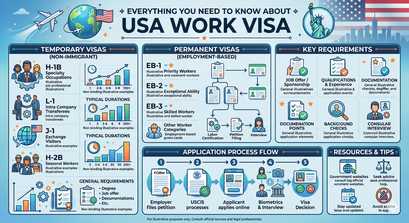
The truth is that “visa sponsorship” in this market usually means one of two things. First, there are temporary non-agricultural jobs under H-2B, which employers use when they can prove a temporary need and a shortage of available U.S. workers. Second, there are some employment-based permanent sponsorship paths, especially the EB-3 category, which includes the “other workers” subcategory for jobs requiring less than two years of training or experience. The path depends on the employer, job duration, business need, and immigration strategy.
This guide explains how the system works, what the jobs actually involve, what salary you can expect, where to search, how to avoid scams, and how to position yourself as a strong candidate.
What Is a Construction Laborer Job in the USA?
A construction laborer is usually an entry-level or semi-skilled worker who supports building crews, contractors, and site supervisors on active job sites. The work is broad and practical. The U.S. Bureau of Labor Statistics describes these workers as people who use, supply, or hold materials and tools, clean work areas and equipment, and assist tradespeople across construction sites. Common duties include cleaning and preparing sites, loading and unloading materials, building or removing temporary structures, digging trenches, compacting earth, operating hand tools and power tools, and assisting electricians, plumbers, and other craft workers.
That is why this keyword has such strong search and ad value. It sits at the intersection of job search, immigration, employment law, salary research, and recruitment intent. People searching this topic are often ready to act. They want applications, sponsorship, relocation, interviews, and sometimes recruitment agency help. That is exactly the kind of high-intent behaviour that makes this a strong pillar topic.
Why Construction Laborer Jobs Are Attractive for Immigrants
Construction laborer roles are attractive because they often do not require a university degree, they can lead to steady earnings, and in some cases they create a path into long-term residence if an employer is willing to sponsor permanently. BLS says the occupation usually has short-term on-the-job training and does not typically require prior related work experience for entry.
For many immigrants, this matters more than prestige. A job that is physically demanding but accessible can be more valuable than a white-collar role that requires years of licensing, credential conversion, or local professional experience. Construction also has a ladder. A laborer can move into specialist roles such as scaffolding, concrete work, framing support, road crew work, equipment handling, site safety support, or helper positions tied to electricians, carpenters, or plumbers. BLS notes that some laborers become construction equipment operators, craft workers, supervisors, or inspectors over time.
Another reason these jobs attract search traffic is that they match several related commercial keywords naturally:
- construction jobs in USA with visa sponsorship
- USA jobs for immigrants with sponsorship
- H-2B jobs in USA
- EB-3 unskilled jobs USA
- construction laborer salary USA
- foreign workers jobs in America
- relocation assistance jobs USA
- visa sponsorship agencies USA
These are not random phrases. They reflect how real applicants search when they are serious about moving.
The Main Visa Sponsorship Routes for Construction Laborers
1. H-2B Visa for Temporary Construction Work
The most realistic and immediate route for many foreign applicants is the H-2B temporary non-agricultural worker program. The U.S. Department of Labor states that the H-2B program allows employers who meet program requirements to hire foreign workers to perform non-agricultural services or labour based on a temporary need. That temporary need must fall into one of four categories: one-time occurrence, seasonal need, peakload need, or intermittent need. Before filing with USCIS, the employer must first obtain an approved temporary labor certification from the Department of Labor.
This matters because many people hear “visa sponsorship” and assume it always means a green card. It often does not. In the construction sector, many sponsorship opportunities are seasonal or project-based. That makes H-2B especially relevant for paving, site prep, pool construction, road work, concrete support, exterior building work, and weather-sensitive projects.
There is also a hard cap. The Department of Labor explains that the H-2B program is capped at 66,000 workers per year. USCIS also reported that, as of March 10, 2026, it had received enough petitions to meet the second-half FY 2026 statutory H-2B cap, and a separate USCIS update said the agency had already received more than enough petitions by February 6, 2026 to reach the cap for the additional 18,490 supplemental H-2B visas available for workers with start dates between May 1 and September 30, 2026. That means timing is not a minor detail. It is critical.
So if you want a construction laborer job in the USA with visa sponsorship for immigrants, you should not treat this like an ordinary job hunt. Apply early, monitor openings constantly, and target employers that already understand the H-2B process.
2. EB-3 for Permanent Employer Sponsorship
The second route is EB-3, the employment-based third preference immigrant category. USCIS says EB-3 covers skilled workers, professionals, and other workers. USCIS also notes that 40,000 visas are available each fiscal year for the overall EB-3 category, and not more than 10,000 may be issued to “other workers,” which is the subcategory most relevant to lower-skill or lesser-training roles.
This route is more attractive if you want a long-term move rather than a seasonal one, but it is also usually slower, more document-heavy, and more dependent on the employer’s willingness to invest time and money in the sponsorship process. Not every construction company wants that. Some only need labour for a busy season. Others may prefer subcontracting or local hiring.
Still, if you find a serious employer with repeated labour shortages and a genuine long-term need, EB-3 can be the stronger path because it aligns with permanent immigration rather than temporary status. That is why many applicants search both H-2B construction jobs and EB-3 unskilled jobs in USA at the same time.
3. Why H-1B Usually Is Not the Right Fit
Some people search broadly and assume any work visa might apply. In reality, H-1B is for specialty occupations, not typical construction laborer positions. USCIS describes H-1B as a classification for people performing services in a specialty occupation. A general labour role on a construction site usually does not match that framework.
That is why a smart content strategy, and a smart job search strategy, focuses on the visas that actually fit the occupation.
What Employers Look for in Foreign Construction Laborers
Construction laborer hiring is more practical than polished. Employers usually care about whether you can show up, follow instructions, work safely, handle tools, endure weather, and stay productive on physically demanding sites. The role often involves lifting, site cleanup, trenching, material movement, and assisting skilled trades. Recent official DOL Seasonal Jobs listings for construction laborers mention duties such as using hand and power tools, cleaning and preparing sites, loading and unloading materials, digging trenches, erecting scaffolding, and lifting up to 50 or even 75 pounds in some postings.
Employers also look for consistency. Can you work full-time hours? Can you handle changing schedules? Can you pass a background check if required? Can you work overtime during peak periods? Several recent DOL postings for construction laborer roles include requirements around pre-hire background checks, drug testing policies, and the ability to lift 50 pounds or more, while applying those rules equally to U.S. workers and H-2B workers.
The strongest profile for this market usually includes:
- basic English communication
- physical fitness and stamina
- willingness to work outdoors
- understanding of site safety
- punctuality and teamwork
- prior labour, warehouse, factory, farm, road, or masonry support experience
- ability to use basic tools
- flexibility around seasonal or project-based work
You do not need to sound corporate. You need to sound reliable.
Salary Expectations for Construction Laborer Jobs in USA with Visa Sponsorship
The national picture is solid. BLS reports a median annual wage of $46,050 for construction laborers and helpers in May 2024, with a median of $46,730 specifically for construction laborers. The lowest 10 percent earned less than $33,610, while the highest 10 percent earned more than $75,560. BLS also shows median wages in major employing industries such as $47,190 in heavy and civil engineering construction, $47,020 in construction of buildings, and $45,560 in specialty trade contractors.
Actual visa-sponsored job ads can vary by location, season, and employer. Recent official DOL SeasonalJobs postings show how broad the real market can be. Examples include $20.29/hour in Wichita, Kansas, $22.76/hour in Crab Orchard, Nebraska, $24.89/hour in Des Moines, Iowa, and $28.19/hour in Telford, Pennsylvania for construction laborer positions listed in early 2026.
That spread is important for two reasons. First, it shows there are real, current job orders in this category. Second, it shows why people also search for related commercial terms such as highest paying construction laborer jobs USA, construction worker pay in America, and best states for construction jobs.
If a role includes overtime, travel, longer seasons, or work in specialty segments such as paving, pool construction, or commercial installation, the effective earnings can be better than the headline wage alone. Some listings also mention performance-based raises, bonuses, or incentives.
Worker Protections You Should Know Before You Apply
One reason official job boards matter is that they show the terms more clearly than random social posts or messaging groups. For example, an official DOL SeasonalJobs construction laborer order states that the employer guarantees work equal to at least three-fourths of the workdays in each 12-week period of the total employment period, provides tools and equipment at no charge, reimburses H-2B workers in the first workweek for visa, visa processing, border-crossing, and related government-mandated fees excluding passport fees, and pays inbound and outbound transportation and subsistence under the applicable rules.
That does not mean every case is perfect or easy. It means you should compare private recruiter claims against official job order language. If someone promises “free visa, free ticket, instant green card, no interview,” you should slow down. Serious U.S. sponsorship is document-based and employer-led, not magic.
Where to Find Legitimate Construction Laborer Jobs with Sponsorship
The best place to begin is the official SeasonalJobs.dol.gov portal, which is run by the U.S. Department of Labor and displays H-2A and H-2B job orders. A search for construction laborers on that site shows multiple listings, wages, begin dates, end dates, and job-order details.
You should also watch for:
- employer career pages of large construction contractors
- state workforce agency referrals listed on official job orders
- reputable staffing firms that clearly disclose visa category and employer name
- immigration attorneys working with employer clients, not “travel agents” pretending to sponsor directly
- trade-specific companies in paving, pool construction, concrete, highway work, and specialty exterior projects
A good rule is simple: if the opportunity cannot be traced to a real employer, a real job order, or a real legal process, treat it as suspicious.
How to Apply Successfully
Step 1: Build a Practical Resume
Your resume for construction laborer jobs in the USA with visa sponsorship should not read like a graduate-school CV. It should be tight, direct, and task-focused. Highlight:
- manual labour experience
- site cleanup
- material handling
- trenching or digging
- scaffolding support
- tool use
- concrete or masonry support
- warehouse or factory labour
- ability to lift heavy materials
- safety awareness
- reliability and attendance
Use simple wording such as “Assisted masons and carpenters on busy building sites,” “Loaded and unloaded construction materials safely,” or “Used hand tools and power tools under supervisor direction.”
Step 2: Match the Employer’s Real Need
If the job is seasonal paving, talk about outdoor work, road work, asphalt support, and long shifts. If the job is pool construction, talk about excavation, material movement, and weather-based site work. If the job is commercial installation, mention tool handling, teamwork, and measuring support. Relevance helps more than decoration.
Step 3: Prepare Your Documents Early
Because H-2B is cap-limited and employer-led, late preparation can kill a good opportunity. Keep these ready:
- valid passport
- resume
- reference contacts
- work history summary
- basic proof of experience if available
- police clearance if an employer later requests it
- educational or trade documents only if relevant
- a short cover message explaining your availability and experience
Step 4: Apply Early in the Hiring Window
The H-2B market moves in waves. If the cap is already full, even a willing employer may not get a slot in time. USCIS updates on cap status make clear how quickly filings can exhaust availability.
Step 5: Be Interview-Ready
Employers often want to know whether you can do the work, communicate on site, and handle the schedule. Expect questions like:
- Have you worked on construction sites before?
- Can you lift heavy materials repeatedly?
- Have you used drills, tampers, saws, or jackhammers?
- Are you comfortable working outdoors in heat or cold?
- Can you follow a foreman’s instructions in English?
- Can you start on the required date?
Best Keyword Strategy for This Topic
Because this is a monetizable pillar post, it should naturally include a cluster of semantically related high-intent phrases, not just one exact-match keyword. The strongest keyword family for this niche includes:
Primary keyword
Construction Laborer Jobs in USA with Visa Sponsorship for Immigrants
Secondary commercial-intent keywords
construction jobs in USA for foreigners
USA visa sponsorship jobs
unskilled jobs in USA with visa sponsorship
H-2B construction jobs USA
EB-3 visa jobs USA
construction worker jobs in America
relocation jobs in USA with sponsorship
general labor jobs in USA for immigrants
visa sponsorship employers in USA
construction laborer salary USA
These phrases work because they map directly to user intent: job discovery, salary comparison, visa pathway, and application action.
Common Mistakes Immigrants Make
The first mistake is confusing temporary sponsorship with permanent immigration. H-2B can be a real entry point, but it is not automatically a green card.
The second mistake is applying through agents who cannot explain the visa type, the employer name, the official job order, or the compensation structure.
The third mistake is ignoring the physical reality of the job. Construction labor is not a desk role. BLS describes it as full-time, physically demanding work that may be outdoors in all weather conditions.
The fourth mistake is sending a generic resume with no labour keywords. Employers need evidence that you can work safely and productively on-site.
The fifth mistake is waiting too long. H-2B caps move fast.
How to Avoid Visa Sponsorship Scams
If you remember nothing else, remember this: real sponsorship is built around a real employer, a real role, and a real legal process.
Be careful if you see any of these signs:
- huge upfront “visa processing” fees to a private individual
- no employer name
- no contract details
- no wage information
- no location
- no visa category
- no explanation of whether the job is H-2B or EB-3
- pressure to pay immediately by WhatsApp or Telegram
- promises of guaranteed approval
Official U.S. job orders are much more specific. They show wage levels, dates, work conditions, and application channels. Official DOL listings also reflect worker-protection requirements such as reimbursement language, tools provided, and transportation rules in covered cases.
Is This a Good Career Path or Just a Survival Job?
It can be either, depending on how you use it.
For some immigrants, a construction laborer job is the fastest practical way to enter the U.S. labour market, earn in dollars, gain local work history, and move toward better trade-based roles. For others, it remains a seasonal or temporary job used to support family goals, savings, or future relocation plans.
The industry itself is large and still growing. BLS projects steady demand tied partly to infrastructure repair and replacement, including roads, water lines, and the power grid. That means construction labour is not just random work. It is connected to real economic need.
If you are disciplined, physically strong, and willing to learn, this job can lead to better pay and more specialized work. If you are looking for instant comfort, it may not be the right fit.
Frequently Asked Questions
Can immigrants get construction laborer jobs in the USA with visa sponsorship?
Yes, but the sponsorship route depends on the employer and the nature of the job. Many temporary opportunities align with the H-2B program, while some long-term roles may be pursued through EB-3 sponsorship.
Is a degree required?
Usually no. BLS says typical entry-level education is not extensive and that the occupation commonly involves short-term on-the-job training.
What is the average salary?
BLS reports a 2024 median pay of $46,050 per year or $22.14 per hour for construction laborers and helpers, though real sponsored postings vary by employer and state.
Are these jobs permanent?
Many visa-sponsored construction labour roles are temporary, especially under H-2B. Some employers may sponsor long-term roles through EB-3, but that is a different and more involved pathway.
Where can I find official H-2B construction jobs?
The U.S. Department of Labor’s Seasonal Jobs portal is one of the most reliable starting points for official H-2B job orders.
Final Thoughts
If you are serious about finding construction laborer jobs in USA with visa sponsorship for immigrants, the best approach is not blind application. It is informed application.
Start with the right visa categories. Understand that H-2B is the most practical temporary route for many construction labour roles, while EB-3 may apply in some employer-sponsored permanent cases. Know the pay range. Use official job portals. Build a labour-focused resume. Apply early. And never treat sponsorship as something a random online agent can “arrange” without a real employer behind it.
This is one of the strongest job-search niches for immigrants because it combines real labour demand, accessible entry requirements, and clear search intent. If you write or publish around this topic, keep the content practical, transparent, and specific. If you apply for these jobs, do the same with your documents and communication. That is what gives you the best chance of turning a search into a sponsored opportunity.